Objective
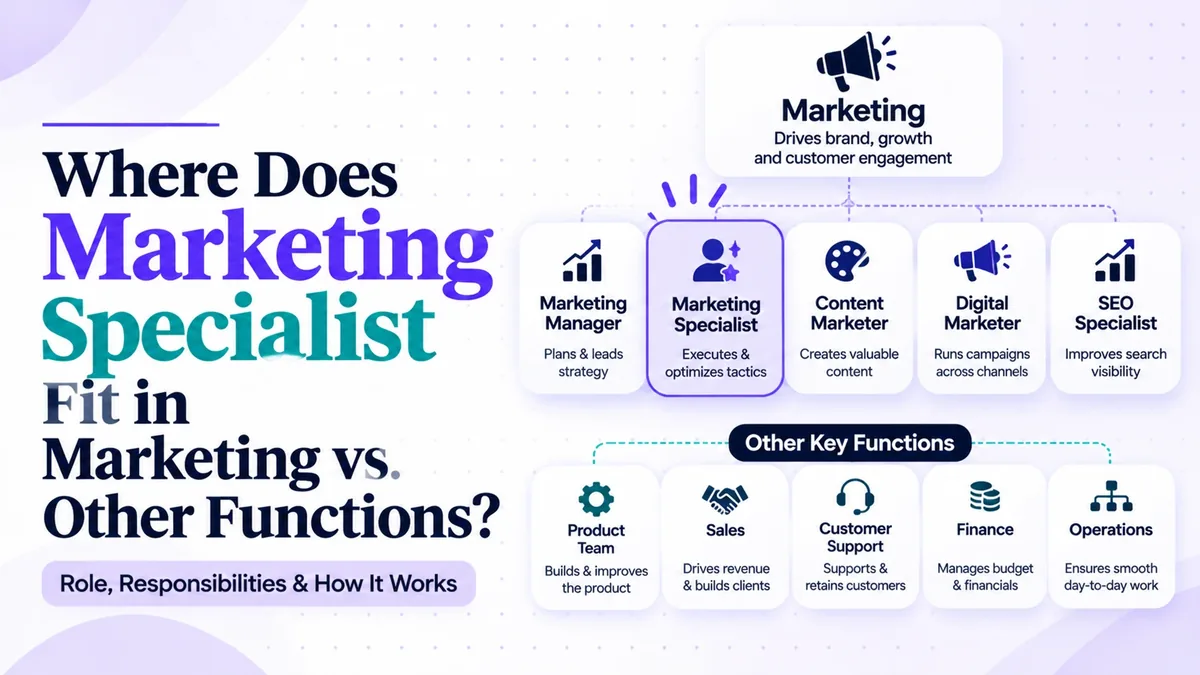
Explain where a marketing specialist sits in the marketing team, how the role differs from nearby roles, and how it works with sales, product, finance and IT.
Key takeaways
- A marketing specialist usually reports to a marketing manager and owns one channel or skill.
- Managers set strategy and budget; specialists run the channel and report results.
- Most of the job's friction is in handoffs with sales, product and data teams.
- Gartner found B2B buyers spend only 17% of buying time meeting suppliers, so marketing covers most of the research stage.
- BLS: median pay $78,760 (May 2025) and 7% projected growth to 2035.
- Startups usually need a generalist first; specialists come once a channel drives revenue.

Pay and job figures are from the U.S. Bureau of Labor Statistics Occupational Outlook Handbook (May 2025 wages, 2025 to 2035 projections), checked in November 2026.
A marketing specialist sits inside the marketing team, usually reporting to a marketing manager, and owns one channel or skill such as SEO, paid ads, email, content, social media or marketing operations. The manager or CMO decides the strategy, budget and targets. The specialist turns that plan into campaigns, runs them and reports what worked. Outside marketing, the specialist hands qualified leads to sales, takes launch details from product, gets reviews and case studies from customer success, and depends on IT or data teams for tracking.
This guide is for founders deciding who to hire, managers drawing an org chart, and people weighing a marketing specialist job. It covers where the role sits, how it differs from the jobs around it, and where the handoffs usually break.
Where a marketing specialist sits in the marketing team
Most marketing teams have three layers:
- Leadership (CMO, VP or head of marketing): sets goals, positioning and budget, and answers to the CEO for growth.
- Management (marketing manager, growth manager, product marketing manager): turns goals into a plan, decides which channels get budget, and manages people and agencies.
- Specialists: run the channels. An SEO specialist owns organic search, a PPC specialist owns Google and Meta ads, an email specialist owns lists and automations, and so on.
The U.S. Bureau of Labor Statistics groups the role with research work under “market research analysts and marketing specialists” (SOC 13-1161). O*NET describes that group as people who research conditions in local, regional, national or online markets, and it lists a separate digital job, the search marketing strategist, whose tasks include optimizing digital assets for SEO and collecting web metrics such as conversion rates and cost per acquisition (O*NET 13-1161.00, O*NET 13-1161.01). In practice the title covers a wide range, which is why job ads for “marketing specialist” read so differently.
Marketing specialist vs other marketing roles
| Role | Main question they answer | Owns | Typical reporting line |
|---|---|---|---|
| Marketing specialist | How do we make this channel work? | One channel or skill, its campaigns and its numbers | Marketing manager |
| Marketing generalist / coordinator | What needs doing this week? | Many small tasks across channels | Marketing manager or founder |
| Marketing manager | Which channels, what budget, what targets? | The plan, the team and agency relationships | Head of marketing or CMO |
| Product marketing manager | How do we position and launch this product? | Messaging, launches, sales enablement | Head of marketing or product |
| Marketing analyst | What is actually working? | Reporting, attribution, forecasting | Marketing ops or data team |
| CMO | How does marketing grow the business? | Strategy, brand and total marketing budget | CEO |
The simplest test: a specialist goes deep on one area, a generalist goes wide across many, and a manager decides between them. Pay follows that line. BLS puts the median wage for market research analysts and marketing specialists at $78,760 in May 2025, against $166,790 for marketing managers (BLS, BLS).
How the marketing specialist works with other functions
This is where the role gets misunderstood. A specialist spends a large share of the week on handoffs with teams outside marketing.
| Function | What the specialist gives them | What the specialist needs from them |
|---|---|---|
| Sales | Qualified leads, campaign context, content for follow-up | Feedback on lead quality and which leads closed |
| Product | Launch campaigns, search and customer demand data | Launch dates, features, screenshots and claims that are true |
| Customer success | Onboarding emails, help content | Reviews, case studies, churn reasons |
| Finance | Spend, cost per lead, cost per sale | Budget, margins and payback targets |
| IT, data and web | Tracking requirements, landing page briefs | Working analytics, CRM fields, site changes and page speed |
| Legal and compliance | Draft ads, emails and claims for review | Approval, consent rules and disclaimers |
Marketing specialist vs sales
Marketing creates and warms demand; sales converts it. The handoff matters more than ever because buyers do much of their research alone. Gartner found that B2B buyers spend only 17% of their buying time meeting potential suppliers (Gartner). The rest goes on independent research, which is exactly the ground a marketing specialist covers with search, content, ads and email. Agree in writing what counts as a qualified lead, how fast sales follows up, and how closed deals are reported back, or each side will blame the other for weak numbers.
Marketing specialist vs product
Product decides what gets built; marketing decides how it is described and who hears about it. Specialists should be told about launches weeks ahead, not on launch day. In return they can bring real demand data: the search terms, ad comments and questions customers use, which often shows product teams how buyers describe the problem.
Marketing specialist vs data and IT
A specialist cannot prove results without tracking that works. If GA4 events, CRM fields or Pixel events are broken, the specialist’s reports are wrong and budget decisions follow them. Give one person clear ownership of tracking, whether that sits in marketing operations or the data team. See how I handle this in a GA4 and GTM tracking audit.
How the role changes with company size
- Startup (1 to 3 marketers): the “marketing specialist” is really a generalist who runs the website, social, email and ads, often reporting to a founder. Hire for range and pick one priority channel.
- Growing company (4 to 15 marketers): specialists appear for the channels that bring most revenue, usually SEO, paid ads and email or lifecycle. A marketing manager coordinates them.
- Enterprise: specialists become narrow (technical SEO, programmatic ads, marketing automation) and may sit in central teams that serve several brands or countries.
- Agency: specialists serve many clients at once, which gives breadth of experience but less time inside any one business.
If you run a young company, see how I help startups and small businesses set up marketing.
Common types of marketing specialist
- SEO specialist: rankings, organic traffic and, now, visibility in AI answers. Related: SEO content strategy.
- PPC or paid media specialist: Google Ads, Meta and LinkedIn campaigns, judged on cost per lead or sale.
- Email and lifecycle specialist: lists, automations and deliverability.
- Content specialist: articles, guides, video scripts and case studies.
- Social media specialist: organic posting, community and creator partnerships.
- Marketing operations specialist: CRM, automation tools, tracking and data. Related: customer data platforms.
- Conversion specialist: landing pages and testing. Related: landing page A/B testing.
Where the setup usually goes wrong
- Specialists without a strategy: each one optimises their own channel and nobody owns the overall number.
- One person, five channels, one title: a “specialist” is asked to be an expert in everything and ends up shallow in all of it.
- No feedback from sales: marketing reports leads, sales reports revenue, and nobody connects the two.
- Reporting in silos: each channel uses its own platform’s numbers, so results add up to more than total sales. One shared dashboard fixes most of this; see Looker Studio reporting.
Career outlook for marketing specialists
BLS counted 952,700 jobs for market research analysts and marketing specialists in 2025 and projects 7% growth from 2025 to 2035, faster than average, with about 82,000 openings a year. Most roles ask for a bachelor’s degree (BLS Occupational Outlook Handbook). The usual path runs from specialist to senior specialist, then either to marketing manager (people and budget) or to a deep expert or consultant role in one channel.
Should you hire a specialist, a generalist or outside help?
Hire a generalist first if you have no marketing yet and need someone to run the basics. Hire a specialist when one channel clearly drives revenue and needs more depth than a generalist can give. Bring in outside help when you need senior strategy or a skill you only use part of the year, such as a site migration or a tracking rebuild. My list of the best digital marketing consultants to hire is a good place to start.
If you are not sure which fits, a digital marketing expert can map your current team against your goals and tell you which role to add next. You can see how I work on the work with me page, or grab the free digital marketing playbook for the full channel-by-channel plan.
Want a second opinion on your marketing team setup? Request a free audit.
- Review of your Google and AI search visibility
- The pages to fix first, in priority order
- A clear 90 day plan, with no obligation
FAQs
Where does a marketing specialist fit in a company?
A marketing specialist sits in the marketing team, usually reporting to a marketing manager. They own one channel or skill, such as SEO, paid ads, email or content, and work with sales, product, customer success, finance and IT to run campaigns and report results.
What is the difference between a marketing specialist and a marketing manager?
A marketing specialist runs one channel and its campaigns. A marketing manager decides which channels get budget, sets targets and manages people. BLS reports a May 2025 median wage of $78,760 for marketing specialists and $166,790 for marketing managers.
Is a marketing specialist part of sales?
No. Marketing specialists create and qualify demand, and sales turns it into revenue. The two teams should agree on what a qualified lead is, how fast leads are followed up and how closed deals are reported back to marketing.
What does a marketing specialist do day to day?
They plan and run campaigns in their channel, write or brief content, manage budgets or tools, check tracking, review results and work with other teams on launches, leads and reporting.
Who does a marketing specialist report to?
Usually a marketing manager. In small companies they may report to a founder or head of marketing, and in large companies to a channel lead within a central team.
Is marketing specialist a good career?
BLS projects 7% job growth for market research analysts and marketing specialists from 2025 to 2035, faster than average, with about 82,000 openings a year. The usual next steps are senior specialist, then marketing manager or a deep expert role.
Should a startup hire a marketing specialist or a generalist first?
Most startups should hire a generalist first to run the basics across channels, then add specialists once one channel clearly drives revenue and needs more depth.