Objective
Explain the real difference between SEO, AEO, GEO and LLMO, and show how to run them as one plan for Google and AI search in 2027.
Key takeaways
- SEO earns rankings and clicks; it is the foundation for the other three.
- AEO makes your page the direct answer in snippets, voice and AI Overviews.
- GEO gets your content cited inside AI answers; quotes, statistics and sources lift visibility.
- LLMO gets your brand named by AI models; brand mentions correlate far more than backlinks.
- Google says optimizing for its AI features is still SEO, and llms.txt is not used by Google Search.
- Only 37.9% of AI Overview citations rank in the top 10, so ranking alone is not enough.
- Measure all four: Search Console's Generative AI report, GA4 AI referrals and monthly prompt tracking.

Every statistic in this guide links to its original source and was checked in November 2026. Figures from Google, Ahrefs, Pew, Peec AI, Semrush, Adobe and the GEO research paper.
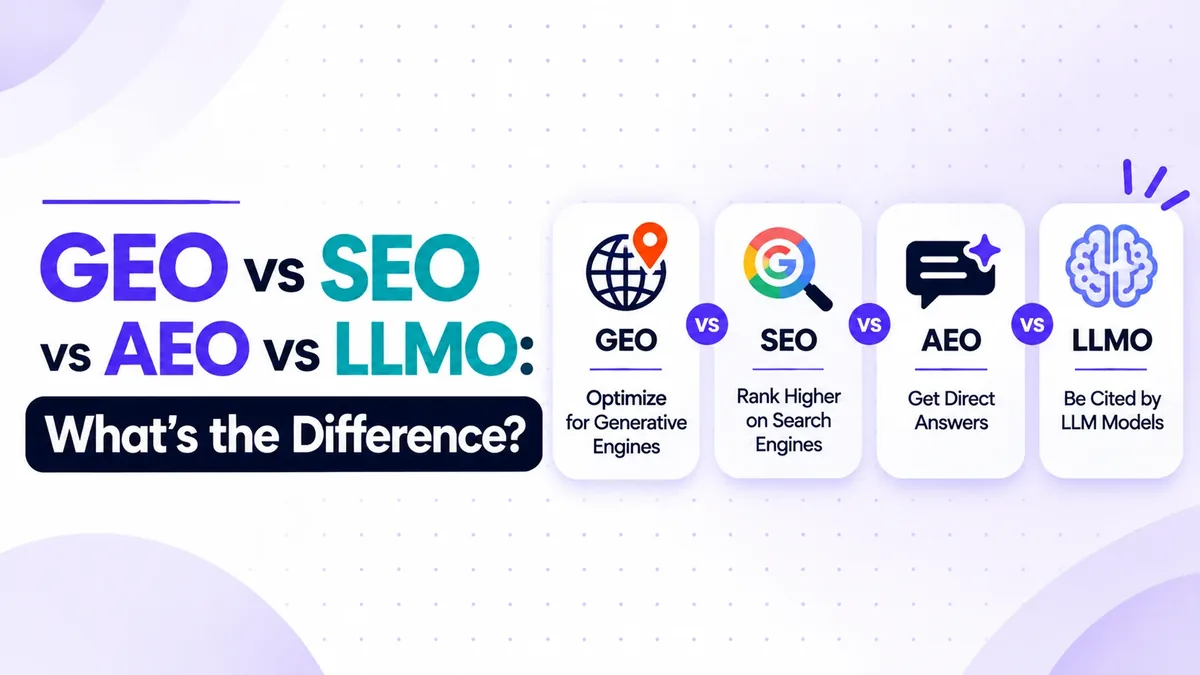
SEO, AEO, GEO and LLMO are four names for one job: being found and trusted when people search, whether the answer comes from a list of links or from an AI. SEO (search engine optimization) earns rankings and clicks in Google and Bing. AEO (answer engine optimization) makes your page the direct answer in featured snippets, voice results and AI Overviews. GEO (generative engine optimization) gets your content cited inside AI-generated answers in ChatGPT, Perplexity, Gemini and Google AI Mode. LLMO (large language model optimization) gets your brand mentioned and recommended by AI models, even when no link is shown. SEO is the foundation for the other three, and Google says optimizing for its AI features “is still SEO” (Google Search Central).
If you are confused by the alphabet soup, you are not alone. Every week a founder asks me whether they need a separate “GEO agency” on top of their SEO retainer. The short answer is no. The longer answer is that the way people search has split across more surfaces, so the way you measure and earn visibility has to widen too. This guide explains what each term means, where they overlap, where they really differ, and how to run all four as one plan for 2027.
GEO vs SEO vs AEO vs LLMO at a glance
| SEO | AEO | GEO | LLMO | |
|---|---|---|---|---|
| Full name | Search engine optimization | Answer engine optimization | Generative engine optimization | Large language model optimization |
| Main goal | Rank pages and win clicks | Be the one direct answer | Be cited as a source in AI answers | Be named and recommended by AI models |
| Where it shows up | Google and Bing organic results | Featured snippets, People Also Ask, voice assistants, AI Overviews | ChatGPT search, Perplexity, Gemini, Google AI Mode and AI Overviews | Chat answers in ChatGPT, Claude, Gemini, Copilot, with or without links |
| What wins | Relevance, links, technical health, helpful content | Clear question-and-answer formatting, concise definitions | Facts, statistics, quotes, original data, sources AI can lift | Brand mentions across the web, consistent entity facts, reviews |
| Unit of success | Ranking position and clicks | Owning the answer box | Citations and share of voice | Mentions and sentiment |
| Main metric source | Search Console, GA4 | Search Console, SERP tracking | Prompt tracking tools, GA4 AI referrals | Prompt tracking tools, brand monitoring |
| Term dates from | Late 1990s | Around 2017 to 2018 | November 2023 research paper | 2023 to 2024 industry use |
Think of them as layers, not rivals. SEO makes your pages eligible to be found. AEO shapes them so a single answer can be pulled out. GEO makes them worth citing. LLMO makes your brand familiar enough that AI models name you without being asked about you.
Why these four terms exist now
Search used to be one surface: ten blue links. In 2026 it is several. At Google I/O in May 2026, Sundar Pichai said AI Overviews now has over 2.5 billion monthly users and AI Mode has passed 1 billion monthly users (Google). In February 2026 ChatGPT reached 900 million weekly active users (TechCrunch).
The pain point every marketer feels is the click. Ahrefs found that when an AI Overview appears, the top-ranking page gets a 58% lower click-through rate than expected, based on December 2025 data across 300,000 keywords (Ahrefs). Pew Research tracked real browsing from 900 US adults and found people clicked a regular result on 8% of searches with an AI summary, against 15% without one. Only 1% clicked a link inside the summary itself (Pew Research Center).
So you can rank first and still lose traffic. That is why AEO, GEO and LLMO became popular: they describe the work of being present inside the answer, not only below it.
What is SEO?
SEO is the practice of improving a website so search engines can crawl, index and rank its pages for the queries your buyers type. It covers technical health (speed, crawlability, mobile usability, structured data), content that matches search intent, internal linking, and authority from links and mentions.
SEO still matters most because every AI search surface leans on a search index. Google is explicit: to appear as a link in AI Overviews or AI Mode, “a page must be indexed and eligible to be shown in Google Search with a snippet” (Google Search Central). If Google cannot crawl or index a page, no amount of GEO will get it cited by Google’s AI.
Success metrics: rankings, organic clicks, impressions, click-through rate, organic leads and revenue.
Need the full fundamentals? My free SEO playbook for 2027 covers technical SEO, content and links in one place.
What is AEO (answer engine optimization)?
AEO is the practice of structuring content so a search engine or assistant can pick it as the single, direct answer to a question. The term is usually credited to Jason Barnard of Kalicube, around 2017 to 2018, when featured snippets and voice assistants started answering questions without a click (Kalicube). Today it also covers AI Overviews.
AEO work looks like this:
- Open each section with a one or two sentence answer, then expand.
- Use the real question as the heading, in the words buyers use.
- Give definitions, steps and comparisons in lists and tables.
- Cover the follow-up questions from People Also Ask on the same page.
- Keep facts like prices, dates and specs current and easy to find.
Success metrics: featured snippet wins, People Also Ask presence, AI Overview appearances and impressions from Google’s AI features.
Read more in my glossary entry on answer engine optimization, or see how I run AEO projects for brands.
What is GEO (generative engine optimization)?
GEO is the practice of making content more likely to be retrieved and cited when a generative AI writes an answer. The name comes from a research paper first posted in November 2023 by researchers from Princeton University, IIT Delhi and other institutions, later accepted at the KDD 2024 conference (arXiv).
The researchers tested nine ways of rewriting content and measured how visible each source became in AI answers. Three changes stood out:
- Adding quotations from credible people lifted visibility by up to 41%.
- Adding statistics lifted it by roughly 30%.
- Citing sources also gave a strong lift.
On the live engine Perplexity, the best methods raised visibility by up to 37%. Keyword stuffing, the old trick, performed worse than doing nothing (GEO paper, arXiv).
The lesson is simple. AI systems prefer content that is specific and verifiable. A vague page that says “results vary” gives an AI nothing to quote. A page that says “ChatGPT traffic converted at 1.81% in a 94-store study” does.
Success metrics: citation frequency across a set of prompts, share of voice against competitors, and AI referral sessions in GA4.
See the glossary entry on generative engine optimization, or how I handle Perplexity citation optimization.
What is LLMO (large language model optimization)?
LLMO is the practice of shaping how large language models understand and describe your brand, so they mention and recommend you in their answers. Unlike GEO, it is not only about your own pages being cited. It is about what the model “knows” from the whole web: reviews, forums, news, directories, videos and your own site.
The best evidence here is about brand mentions. Ahrefs studied 75,000 brands and found that branded web mentions had a 0.664 correlation with AI Overview brand visibility, against just 0.218 for backlinks (Ahrefs). Ahrefs is careful to say correlation is not causation, but the gap is large.
Where those mentions live matters too. Peec AI analysed 30 million cited sources across ChatGPT, Google AI Mode, Gemini, Perplexity and AI Overviews. The most cited domains were Reddit, YouTube, LinkedIn, Wikipedia and Forbes (Peec AI). Those mixes shift quickly: Semrush tracked ChatGPT’s share of Reddit citations falling sharply in September 2025 (Semrush). So do not bet everything on one platform.
Success metrics: how often AI names your brand for category prompts, how accurately it describes you, sentiment, and where you rank in AI “best of” lists.
Curious what ChatGPT says about your business right now? A ChatGPT brand visibility audit shows it, and LLM brand mention optimization is how you change it.
How are they the same?
All four reward the same core things: a site search engines can crawl, content that answers real questions well, and a brand other people talk about. Google’s own guide says there are no special tricks for its AI features. It says you do not need llms.txt files, special schema or “chunked” content to appear in AI Overviews or AI Mode (Google Search Central).
The overlap is why a split strategy fails. If one agency writes for rankings and another rewrites the same pages “for AI”, you get two teams pulling the same content in different directions.
How are they different?
They differ in three practical ways:
- The surface. SEO targets the results page. AEO targets the answer box. GEO targets the AI answer and its source list. LLMO targets the model’s description of you.
- The unit you win. SEO wins a click. AEO wins the answer. GEO wins a citation. LLMO wins a mention.
- Where the signal comes from. SEO and AEO depend mostly on your own pages. GEO depends on your pages plus how quotable they are. LLMO depends heavily on what other sites say about you.
There is one more difference people miss. Ranking well in Google no longer guarantees an AI Overview citation. In March 2026 Ahrefs found that only 37.9% of URLs cited in AI Overviews also ranked in the organic top 10, down from about 76% in mid-2025. Around 31% came from beyond the top 100 (Ahrefs). SEO gets you in the door. The answer-shaped, fact-rich work of AEO and GEO decides whether you are quoted.
Which one should you prioritise?
Do not choose one. Sequence them:
- Your site has technical problems or thin content: start with SEO. Nothing else works until pages are indexed and useful.
- You rank but traffic is falling: add AEO. Rework your top pages so each section opens with a clear answer and add question-led sections.
- Competitors appear in ChatGPT and Perplexity and you do not: add GEO. Publish original data, add sourced statistics and expert quotes, and keep key pages fresh.
- AI tools describe your brand wrongly or never recommend you: add LLMO. Fix your entity facts everywhere, earn reviews and mentions on the sites AI cites, and show up in community discussions.
Is AI traffic worth the effort? It converts well but is still small. Visibility Labs studied 94 ecommerce brands’ GA4 data for 2025: ChatGPT visitors converted at 1.81% against 1.39% for non-branded organic, about 31% higher. But ChatGPT drove about $474,000 in revenue against $32.1 million from organic (Search Engine Land). Adobe saw AI traffic to US retail sites rise 693.4% in the 2025 holiday season (Adobe). Small base, steep growth, high intent. That is a reason to start now, not a reason to abandon SEO.
One workflow that covers all four
This is the order I use with clients:
- Fix the foundation. Crawlability, indexing, speed and mobile. Make sure important pages are not blocked with
noindexornosnippet, since those also keep them out of Google’s AI features. - Map questions, not only keywords. Pull questions from Search Console, People Also Ask, sales calls and Reddit threads. Group them by intent so each page owns one job.
- Write answer-first. One clear answer at the top of each section, then detail, examples and a table where it helps.
- Add proof. Original numbers, named sources, dates and expert quotes. This is the part the GEO research shows AI engines reward.
- Make your entity consistent. Same name, description, founder, location and services on your site, Google Business Profile, LinkedIn, directories and review sites. See AI search entity optimization.
- Earn mentions where AI looks. Reviews, podcasts, YouTube, LinkedIn posts, industry press and helpful answers in communities. Google warns against fake or paid “inauthentic” mentions, so keep it real.
- Refresh on a schedule. Ahrefs found AI assistants cite content that is about 25.7% fresher than what ranks in classic results, with the effect strongest in ChatGPT and Perplexity (Ahrefs).
- Measure every surface (next section).
How to measure SEO, AEO, GEO and LLMO
- Google Search Console: the Performance report for classic SEO, plus the new Generative AI performance report. Google rolled it out to all sites from August 31, 2026. It shows impressions from AI Overviews and AI Mode, but not clicks (Search Console Help).
- GA4: build a segment for referrals from chatgpt.com, perplexity.ai, gemini.google.com, copilot.microsoft.com and claude.ai, and track their conversions separately.
- Prompt tracking: a fixed list of 30 to 100 buyer prompts, run monthly across ChatGPT, Perplexity, Gemini and AI Mode. Record whether you are mentioned, cited and recommended, and who is named instead. Google notes no third-party tool has access to its AI systems, so treat these tools as samples, not truth.
- Brand monitoring: track unlinked mentions, reviews and sentiment, since these feed LLMO.
If you want this done for you, my AI search visibility consulting sets up the prompts, tracking and monthly reporting.
Common myths and mistakes in 2026
- “You need an llms.txt file to rank in AI.” Not for Google. Its guide says Google Search does not use llms.txt. The file was proposed in September 2024, and an Ahrefs study in June 2026 found that 97% of llms.txt files got zero requests in a month (Ahrefs). It is harmless, but it is not a strategy.
- “Add FAQ and HowTo schema to get into AI answers.” Google stopped showing HowTo rich results in 2023 and FAQ rich results stopped appearing in May 2026 (Google Search Central). Structured data still helps search engines understand a page, but Google says it is not required for AI features. Write good FAQs for people. Do not expect markup alone to win citations.
- “Rank #1 and AI will cite you.” Only 37.9% of AI Overview citations come from the top 10, as shown above.
- “Rewrite everything into tiny chunks for AI.” Google says chunking is not needed. Write well-organised pages for humans.
- “Stuff in more keywords.” The GEO research found keyword stuffing made AI visibility worse.
- Checking whether you are opted in. Google’s guide now says a site must be included in the “Search generative AI features” setting in Search Console to be eligible for its AI features. Check that setting before anything else (Google Search Central).
My take for 2027
The labels will keep changing. The work will not. Build a technically sound site, answer real questions clearly, back every claim with proof, and give people reasons to talk about your brand. Do that and you will rank in Google, appear in AI Overviews and get recommended by ChatGPT, whatever the industry calls it next year.
If you want one plan that covers search and AI together, work with a digital marketing expert who measures both. If you are comparing outside help first, see the best digital marketing consultants to hire. You can also see how I approach agentic AI SEO for sites that AI agents need to use, not just read.
Not sure where your brand stands? Request a free audit and I will show you how you appear in Google and in AI answers today.
- Review of your Google and AI search visibility
- The pages to fix first, in priority order
- A clear 90 day plan, with no obligation
FAQs
What is the difference between SEO, AEO, GEO and LLMO?
SEO earns rankings and clicks in search results. AEO makes your page the direct answer in featured snippets and AI Overviews. GEO gets your content cited inside AI-generated answers. LLMO gets your brand mentioned and recommended by AI models like ChatGPT. SEO is the foundation for the other three.
Is GEO replacing SEO?
No. AI search tools rely on search indexes, and Google says optimizing for its AI features is still SEO. A page must be indexed and eligible for a snippet to appear as a link in AI Overviews or AI Mode. GEO adds to SEO rather than replacing it.
Is AEO the same as GEO?
They overlap but are not the same. AEO focuses on being the single direct answer, such as a featured snippet or voice result. GEO focuses on being one of the cited sources inside a longer AI-generated answer in tools like ChatGPT, Perplexity and Google AI Mode.
What is LLMO in marketing?
LLMO, or large language model optimization, is the work of shaping how AI models understand and describe your brand so they mention and recommend you. It relies heavily on consistent brand facts and genuine mentions across reviews, forums, news, video and social sites.
Do I need llms.txt for AI search?
Not for Google. Google says its Search does not use llms.txt, and an Ahrefs study in June 2026 found 97% of llms.txt files received zero requests in a month. It is harmless to have one, but it will not improve rankings or AI citations on its own.
Does schema markup help with AI Overviews?
Google says structured data is not required to appear in its AI features, and FAQ rich results stopped appearing in May 2026. Schema still helps search engines understand your pages, but clear, factual content matters more for AI citations.
How do I track visibility in AI Overviews and AI Mode?
Use the Generative AI performance report in Google Search Console, which shows impressions from AI Overviews and AI Mode for all sites since August 31, 2026. Add GA4 segments for AI referrals and run a fixed set of buyer prompts monthly to track mentions.
Which should a small business focus on first?
Start with SEO so your pages are indexed, fast and useful. Then rewrite key pages answer-first for AEO, add sourced facts and original data for GEO, and build consistent listings and reviews for LLMO.