Objective
Understand the 4 Ps of marketing clearly, see how real brands use them, and learn how to audit your own marketing mix for search and AI visibility.
Key takeaways
- The 4 Ps of marketing are product, price, place and promotion, first set out by E. Jerome McCarthy in 1960.
- All four Ps must send the same signal about quality, or buyers hesitate.
- Price is the fastest profit lever: McKinsey found a 1% price rise lifts operating profit by 8.7% on average.
- Place now includes AI assistants: 45% of US consumers use AI tools for local recommendations (BrightLocal, 2026).
- Service businesses should use the 7 Ps, which add people, process and physical evidence.
- Attach a metric to every P, and review your mix every quarter.

I learned the 4 Ps in a classroom, but I really understood them sitting with clients who had a great product and no idea why it was not selling. Nine times out of ten, one P was out of step with the other three. This guide is the checklist I use to find it.
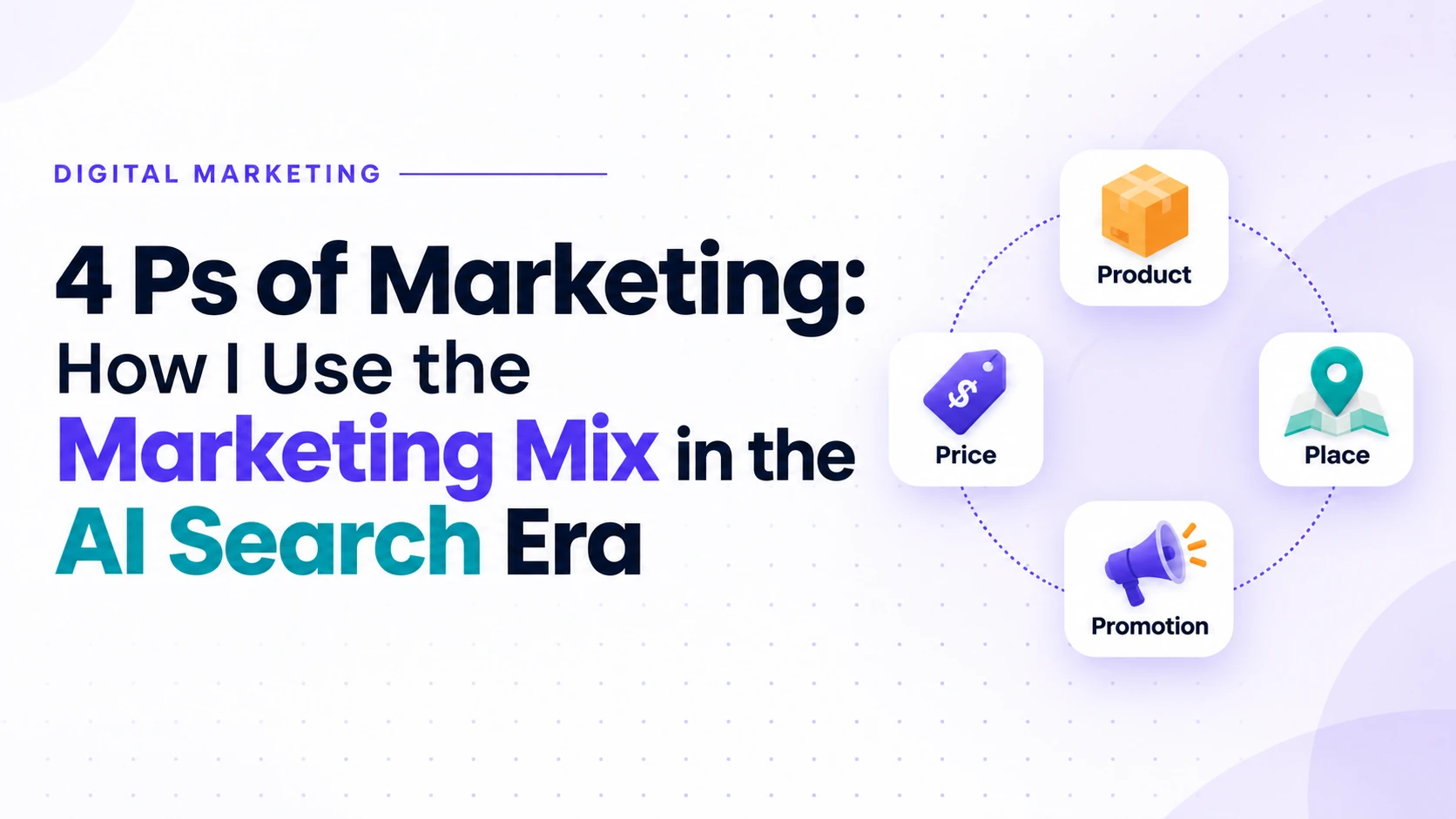
The 4 Ps of marketing are product, price, place and promotion. Together they make up the marketing mix: the four decisions every business makes before a customer buys. Get one wrong, and the other three have to work twice as hard.
The framework is older than television advertising in most homes, yet it still fills search results. Before writing this guide I pulled a Semrush export of the US keywords people use for this topic. It holds 351 unique searches worth 108,580 searches a month, and Google shows an AI Overview for 98.3% of them. People want a clear, quick answer, and Google is now giving that answer itself.
So this guide does two jobs. It explains each P plainly, with real brand examples. Then it shows how I apply the 4 Ps for clients today, when “place” includes ChatGPT answers and “promotion” includes being cited by AI.
What are the 4 Ps of marketing?
The 4 Ps of marketing are a framework for planning how you bring an offer to market. Product is what you sell. Price is what customers pay. Place is where and how they buy. Promotion is how they hear about it. E. Jerome McCarthy introduced the four-part model in 1960, in his textbook Basic Marketing: A Managerial Approach.
McCarthy did not invent the idea of a “mix”. Harvard professor James Culliton described marketers as “mixers of ingredients” in 1948, and his colleague Neil Borden made the term “marketing mix” popular in his 1953 American Marketing Association address. McCarthy’s gift was making it simple enough to remember.
| P | The question it answers | Typical decisions |
|---|---|---|
| Product | What problem do we solve, and for whom? | Features, quality, design, packaging, range, support, warranty |
| Price | What value will customers pay for? | List price, discounts, tiers, payment terms, bundles |
| Place | Where will customers find and buy it? | Website, marketplaces, stores, distributors, search and AI visibility |
| Promotion | How will they hear about it and trust it? | Ads, SEO, content, social, PR, email, reviews |
What people really want to know about the 4 Ps
Search data shows what readers care about, so I let it shape this guide. Here is what the 351 keywords in that Semrush export (US database, November 2026) tell us.
| What the data shows | Number | What it means for you |
|---|---|---|
| Unique keyword variations | 351 | People phrase this topic in hundreds of ways (“4ps”, “four p’s”, “4 piece of marketing”) |
| Combined monthly US searches | 108,580 | An evergreen topic with steady demand |
| Searches with an AI Overview | 98.3% | Google answers most of these queries directly at the top of the page |
| Searches with “People also ask” | 98.0% | Short question-and-answer content wins visibility |
| Searches showing video results | 100% | Many learners prefer a visual explainer |
| “What is” or “define” searches | 72 keywords, 25,220 searches | Most people want the definition first |
| “Example” searches | 28 keywords, 3,490 searches | The next need is seeing it applied to real brands |
| Informational intent | 98% of keywords | Readers are learning, not buying, so teach before you sell |
That last point matters. If you build a page on a topic like this, lead with the answer and examples. A hard sales pitch will lose the reader. For more data like this, see my digital marketing statistics page.
The 4 Ps explained, with examples
For each P, I cover what it is, why it matters, a brand that does it well, and the questions I ask clients in a strategy session.
1. Product: what you sell and why it matters to the buyer
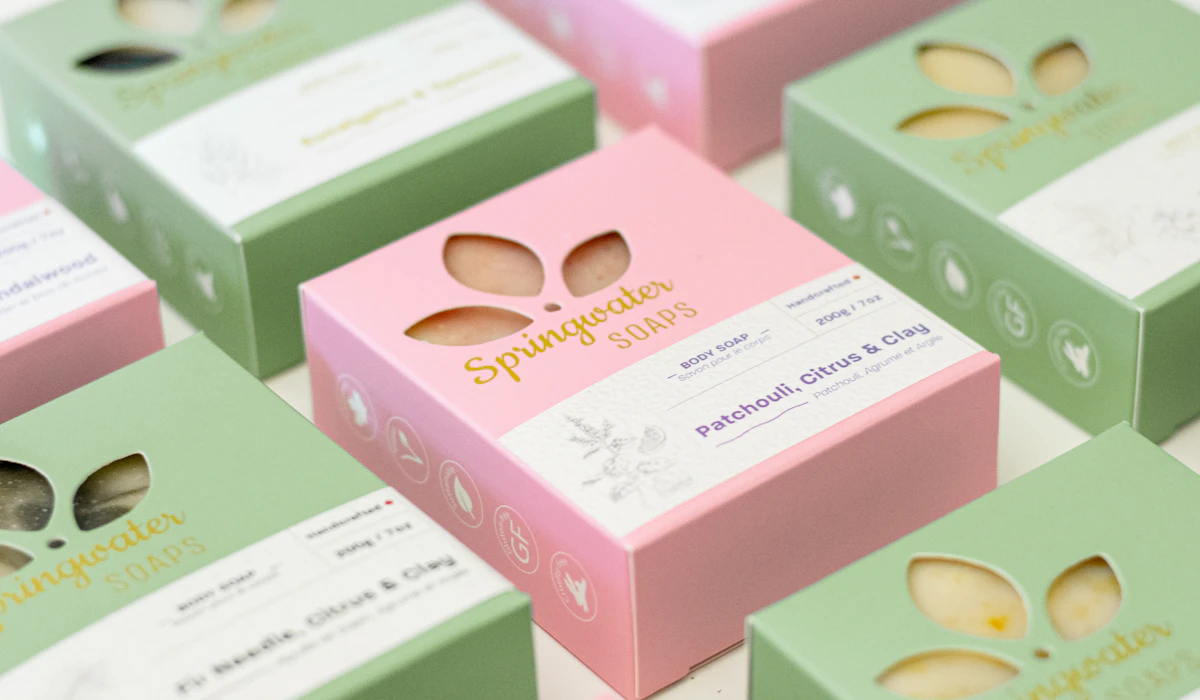
Product covers everything a customer receives: the core item or service, its design, quality, packaging, name, support and guarantee. In my experience, most marketing problems are product problems in disguise. If the offer does not solve a real pain clearly, no ad budget will fix it.
Brand example: Apple’s iPhone line is a classic product strategy. It offers a small number of models at clear tiers, with a consistent design, and ties the hardware into its own services such as iCloud and the App Store. The product itself keeps customers in the ecosystem.
Questions to ask yourself:
- What single problem does my product solve better than the alternatives?
- Which features do customers actually use, and which could I remove?
- Does my packaging, onboarding or support make the product feel worth its price?
2. Price: the P that moves profit fastest
Price is what customers pay, including discounts, payment terms, subscriptions and bundles. It is also a signal. A low price can say “bargain” or “cheap”; a high price can say “premium” or “overpriced”. The right answer depends on your product and your audience.
Price is the most powerful lever in the mix. McKinsey’s pricing research found that a 1% price increase lifts operating profit by 8.7% on average, assuming sales volume holds. Very few marketing campaigns can match that.
Brand example: Spotify uses tiered pricing. A free, ad-supported plan brings people in. Premium individual, Duo, Family and Student plans then match price to how different listeners use the service.
Questions to ask yourself:
- Do I price on cost, on competitors, or on the value customers get?
- Would a good, better, best set of tiers help more buyers say yes?
- Am I training customers to wait for discounts?
3. Place: where customers find and buy you
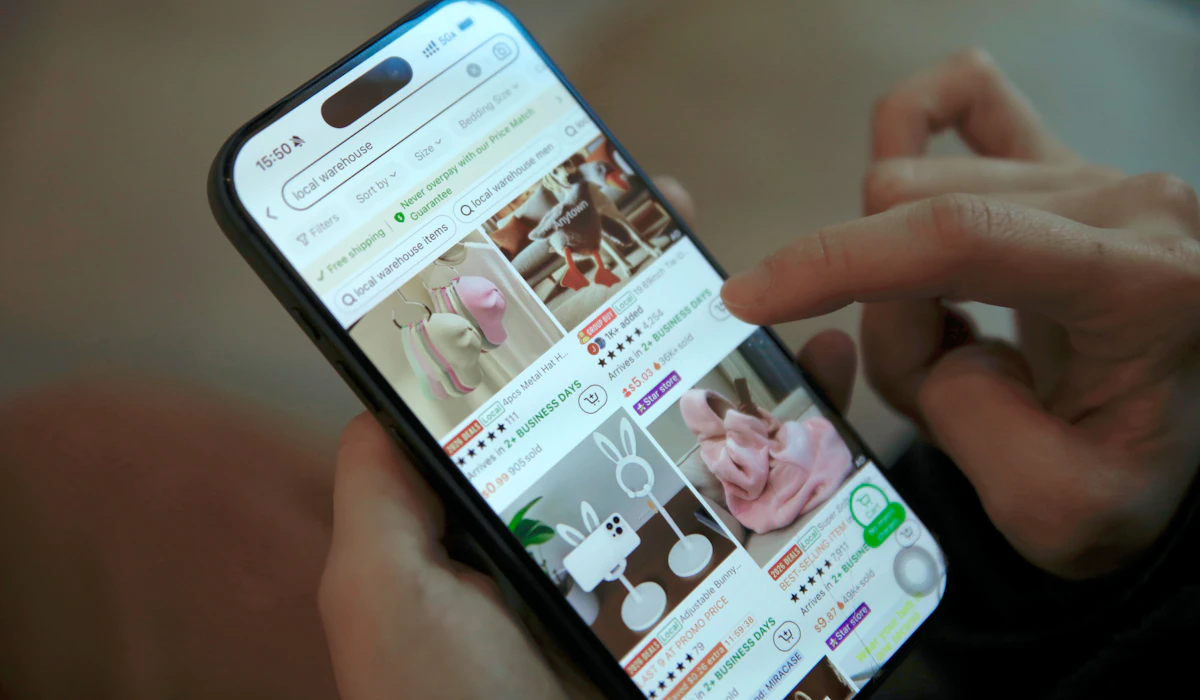
Place is distribution: every channel where people can discover, compare and buy your offer. In 1960 that meant shops and wholesalers. Today it also means your website, Amazon, Google Shopping, app stores, Google Maps and, more and more, AI assistants.
This is where I see the biggest shift. BrightLocal’s Local Consumer Review Survey 2026 found that 45% of US consumers now use ChatGPT or other AI tools for local business recommendations, up from 6% a year earlier. If AI tools do not mention you, you are missing from a channel your buyers already use. Brands with several branches feel this most, which is why I built a dedicated multi-location AI SEO service.
Brand example: Nike runs a mix of channels. It sells direct through its own app and website, runs its own stores, and still works with selected retail partners. Each channel serves a different kind of buyer.
Questions to ask yourself:
- Where do my best customers start their search: Google, Maps, a marketplace or an AI tool?
- Can people buy from me in the fewest clicks on mobile?
- When I ask ChatGPT or Gemini for a recommendation in my category, does my brand appear? (My AI visibility report shows how to check.)
4. Promotion: how people hear about you and why they trust you
Promotion is every way you communicate the offer: advertising, search engine optimization (SEO), content, social media, email, PR, events and reviews. The aim is simple. Reach the right people, at the right moment, with a message that earns trust.
Budgets are tight, so promotion has to be efficient. Gartner’s 2025 CMO Spend Survey found marketing budgets flat at 7.7% of company revenue, with paid media taking 30.6% of that budget. That is why I push clients toward channels that keep paying back, such as SEO and word-of-mouth marketing, alongside paid ads.
Brand example: Coca-Cola’s “Share a Coke” campaign printed popular first names on bottles. It turned packaging (product) into promotion, and customers did much of the sharing on social media for free.
Questions to ask yourself:
- Which channel brings my most profitable customers, not just the most clicks?
- Do I have reviews, case studies and expert content that build trust?
- Is my message the same across ads, website, social and sales calls?
Pro tip: The 4 Ps only work as a set. A premium price needs a premium product, a premium place and premium promotion. When one P sends a different signal from the rest, buyers notice and hesitate.
4 Ps of marketing example: one business, all four decisions
Here is how I would map the 4 Ps for an example business: a direct-to-consumer skincare brand selling in the USA.
| P | Decision | How we measure it |
|---|---|---|
| Product | Three hero products for one skin concern, with clear ingredient pages and a 30-day guarantee | Repeat purchase rate, return rate, review rating |
| Price | Single items plus a discounted three-step bundle and a subscribe-and-save option | Average order value, margin per order |
| Place | Own Shopify store, Amazon, Google Shopping, and visibility in AI shopping answers | Share of sales by channel, AI mentions |
| Promotion | SEO content on skin concerns, creator videos, email flows and remarketing | Customer acquisition cost, return on ad spend |
Notice that each row has a number attached. A marketing mix without measurement is just a list of ideas.
4 Ps vs 7 Ps vs 4 Cs: which model should you use?
The 4 Ps were built for physical products. Two popular extensions fix their gaps. In 1981, Bernard Booms and Mary Jo Bitner added people, process and physical evidence to create the 7 Ps for service businesses. In 1990, Robert Lauterborn proposed the 4 Cs, which look at the same decisions from the customer’s side.
| 4 Ps (seller view) | 4 Cs (customer view) | Extra 3 Ps for services |
|---|---|---|
| Product | Customer needs and wants | People: staff who deliver the service |
| Price | Cost to the customer (money, time, effort) | Process: how the service is delivered |
| Place | Convenience | Physical evidence: proof such as reviews, office, website |
| Promotion | Communication (a two-way conversation) |
What to do: If you sell physical products, start with the 4 Ps. If you sell a service such as consulting, healthcare or education, use the 7 Ps, because your people and process are the product. Use the 4 Cs as a check that every decision makes sense to the buyer.
4 Ps of marketing checklist
Use this table to audit your own marketing mix. Score each line honestly.
| Check | Where to look | Urgency if it fails |
|---|---|---|
| Product solves one clear problem for a defined audience | Customer reviews, sales call notes | High |
| Price matches the value and position of the brand | Competitor pricing, margin reports | High |
| Buyers can find you on Google, Maps and AI assistants | Google Search Console, Google Business Profile, AI prompts | High |
| Checkout or enquiry works in a few taps on mobile | Analytics funnel, session recordings | Medium |
| Promotion budget goes to channels that bring profit, not just clicks | Ad platforms, CRM revenue by source | Medium |
| All four Ps send the same message about quality | Website, ads, packaging, sales scripts | Medium |
From my client work: where the 4 Ps meet real results
I have used this framework with clients for more than two decades. Two results from my team at SEO Discovery show how much “place” and “promotion” now depend on search.
Chokhi Dhani, Dubai (hospitality). For a restaurant, place is not just the address. It is the map pack and every “near me” search. With a focus on local SEO, organic traffic grew 937.5% to 24,900 visits, with #1 rankings for 400+ local keywords.
ACKO (insurance). Insurance is hard to differentiate on product alone, so promotion through content and search carries a lot of weight. Monthly organic traffic grew from 2M to 6M, with 803K ranking keywords and a #1 position for “car insurance”, one of India’s most competitive terms.
Result: In both cases, the product was already good. Growth came from making sure customers could find it, compare it and trust it at the moment they searched.
What’s changing with AI: the 4 Ps in 2026
AI search does not replace the 4 Ps. It changes where each one is judged. Google said in July 2025 that AI Overviews had over 2 billion monthly users. Buyers now meet your brand inside a summary before they reach your website.
- Product: AI tools compare features and summarize reviews. Clear product facts, specs and structured data help them describe you correctly.
- Price: Shoppers ask AI for “the best option under $100”. Visible, consistent pricing across your site and marketplaces makes you easier to recommend.
- Place: AI Overviews, ChatGPT and Gemini are now discovery channels. Track your AI visibility the way you track rankings.
- Promotion: AI models lean on what others say about you. Reviews, press and brand mentions on trusted sites matter more than ever.
Mandeep’s take: Most businesses treat the 4 Ps as a classroom diagram and forget it. That is a mistake. I review a client’s mix every quarter, because the market moves even when the product does not. The P that most teams neglect today is place: they rank on Google but never check whether AI assistants recommend them.
Conclusion
The 4 Ps of marketing are simple to learn and hard to master. Product, price, place and promotion have to agree with each other, and they have to be measured. The framework from 1960 still works, as long as you update what “place” and “promotion” mean in an age of AI answers.
If you want a second pair of eyes on your marketing mix, I am happy to help. My team audits all four Ps, with a focus on search and AI visibility. Whether you run a startup, a small business or a brand selling in the USA, book a free strategy call and we will find the P that is holding you back.
- Review of your Google and AI search visibility
- The pages to fix first, in priority order
- A clear 90 day plan, with no obligation
FAQs
What are the 4 Ps of marketing?
The 4 Ps of marketing are product, price, place and promotion. They are the four decisions a business makes to bring an offer to market: what it sells, what it charges, where customers buy it, and how customers hear about it. E. Jerome McCarthy introduced the model in 1960.
Who created the 4 Ps of marketing?
E. Jerome McCarthy created the 4 Ps in his 1960 textbook Basic Marketing: A Managerial Approach. He built on the marketing mix idea from Harvard professors James Culliton, who wrote about it in 1948, and Neil Borden, who made the term popular in 1953.
What is an example of the 4 Ps of marketing?
Spotify is a clear example. Its product is streaming music and podcasts, its price uses free and paid tiers, its place is apps on phones, computers and smart speakers, and its promotion relies on playlists, partnerships and the yearly Wrapped campaign that users share on social media.
What is the difference between the 4 Ps and the 7 Ps?
The 7 Ps add people, process and physical evidence to the original 4 Ps. Bernard Booms and Mary Jo Bitner proposed them in 1981 for service businesses, where staff, delivery and proof such as reviews shape the customer experience as much as the core offer.
Are the 4 Ps of marketing still relevant in 2026?
Yes. The four decisions never go away, but where they play out has changed. Place now includes marketplaces, Google Maps and AI assistants, and promotion includes reviews and brand mentions that AI tools use when they recommend businesses.
What are the 4 Ps of digital marketing?
The 4 Ps of digital marketing are the same four elements applied online. Product includes the website and user experience, price covers online offers and subscriptions, place covers search, marketplaces and AI answers, and promotion covers SEO, paid ads, social media, email and content.
Which of the 4 Ps is most important?
None works alone, but price often moves profit the fastest. McKinsey research found that a 1% price increase lifts operating profit by 8.7% on average when volume holds. Still, a strong price only holds when the product, place and promotion support it.