Objective
Find the exact category a digital marketing consultant belongs to in each ecommerce and business taxonomy, and know which one to use when.
Key takeaways
- In Shopify's Standard Product Taxonomy, use Services > Professional Services > Marketing & Advertising (se-7-5).
- Google's product taxonomy has 5,596 categories and no services group, so consulting does not belong in Google Shopping.
- For company registration and tax in North America, the code is NAICS 541613, Marketing Consulting Services.
- On Google Business Profile, choose Marketing consultant as the primary category.
- Describe the offer with schema.org Service, not the deprecated ProfessionalService type.
- Use the same label everywhere so platforms and AI tools understand what you sell.
- 45% of consumers now use AI tools for local recommendations (BrightLocal 2026), so matching categories across platforms also helps AI answers.

I wrote this after one too many conversations with consultants who could not get their services to sync, show up on Maps, or appear in AI answers. In almost every case, the fix started with one boring question: what category are you in? Here is the answer for every system that asks.
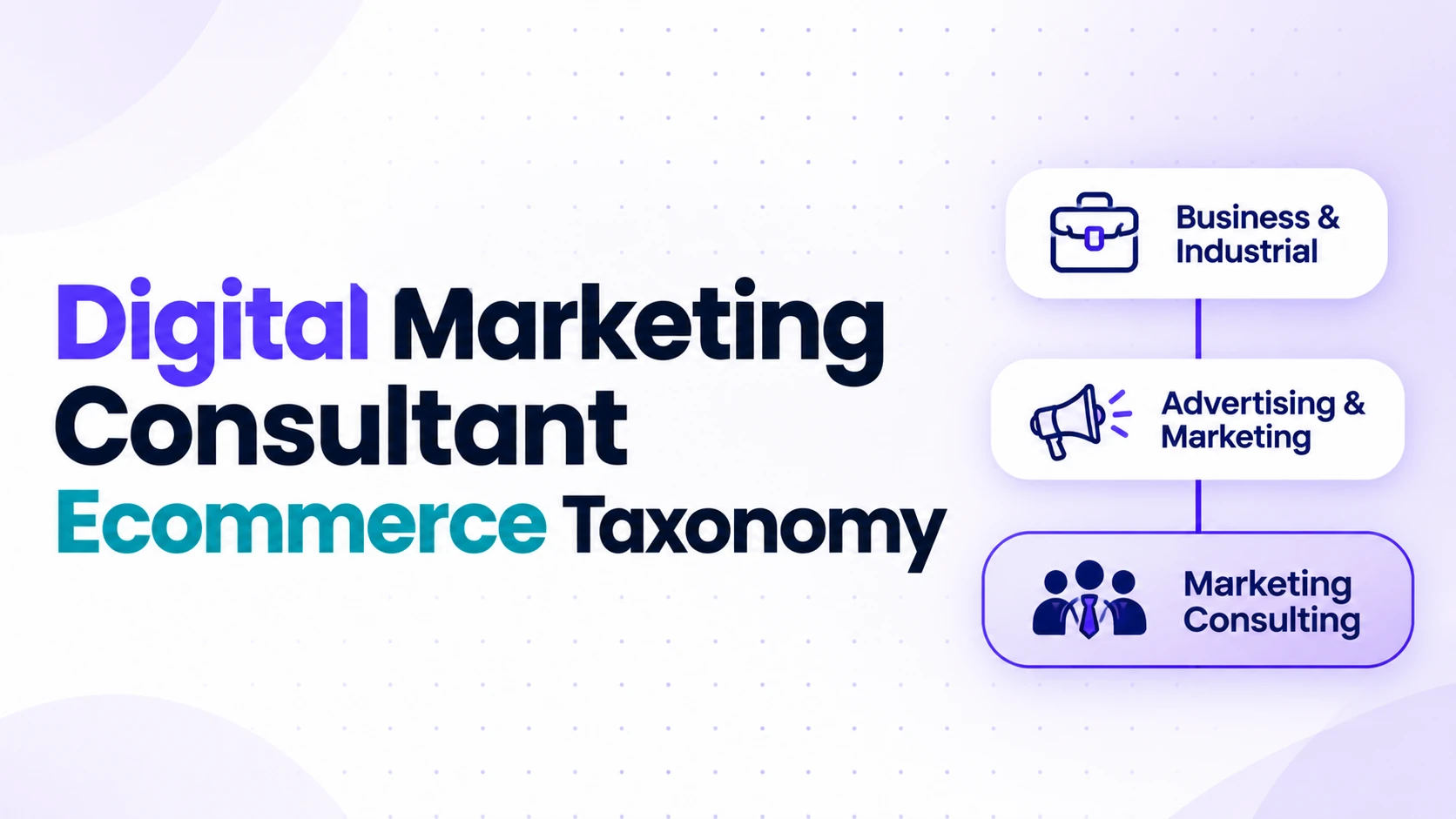
Short answer: in an ecommerce taxonomy, a digital marketing consultant belongs under Services > Professional Services > Marketing & Advertising. That is the exact path in Shopify’s Standard Product Taxonomy. If your platform has no marketing branch, the closest match is Services > Professional Services > Consulting Services.
The catch is that not every taxonomy has a home for services. Google’s product taxonomy, which powers Google Shopping, has no service category at all. And outside ecommerce, the same consultant is classified as NAICS 541613, Marketing Consulting Services, and as a “Marketing consultant” on Google Business Profile.
I checked each taxonomy at its source: Shopify’s category file on GitHub, Google’s product taxonomy file, the NAICS manual, the UN classifications and Google Business Profile. The table below gives the path and code for each; the sections after it explain when to use which, and the mistakes I see most often.
Where does a digital marketing consultant sit in each taxonomy?
A digital marketing consultant sells expertise, not a physical item, so the right category depends on which system is asking. Ecommerce platforms use product taxonomies, governments use industry codes, and Google Maps uses business categories. Here is the answer for each one.
| Taxonomy | Where a digital marketing consultant belongs | Code or ID | When you need it |
|---|---|---|---|
| Shopify Standard Product Taxonomy | Services > Professional Services > Marketing & Advertising | se-7-5 | Selling audits, retainers or strategy calls in a Shopify store |
| Shopify (fallback) | Services > Professional Services > Consulting Services | se-7-1 | General business consulting with some marketing |
| Google Product Taxonomy | No service category exists | None | Google Shopping and Merchant Center (services are not a fit) |
| NAICS (USA, Canada, Mexico) | Marketing Consulting Services | 541613 | Company registration, tax forms, government contracts |
| UN CPC | Marketing management consulting services | 83114 | International trade and statistics |
| ISIC Rev. 4 | Management consultancy activities | 7020 | International industry statistics |
| UNSPSC | Segment 80, family “Marketing and distribution” | 80140000 | Supplier and procurement portals |
| Google Business Profile | Marketing consultant (primary) | Category name | Google Maps and local search |
| Schema.org | Service, with serviceType “Digital marketing consulting” | Type name | Structured data on your website |
If you only remember one row, make it the first. For an online store that sells marketing services, Marketing & Advertising under Professional Services is the most precise category available today.

Ecommerce taxonomy: Shopify vs Google, side by side
This is where most confusion comes from. People search for “ecommerce taxonomy” expecting one standard list, but the two most used lists treat services very differently.
Shopify’s Standard Product Taxonomy has a Services branch
Shopify’s Standard Product Taxonomy is published openly on GitHub. When I pulled the November 2026 category file, it held 14,606 categories across 26 top-level groups. One of those top-level groups is Services, and inside it, Professional Services has eight sub-categories:
- Consulting Services
- Finance & Insurance
- IT & Technology
- Legal Services
- Marketing & Advertising
- Property Management
- Real Estate
- Tax Services
Shopify says the category you assign affects how products sync to sales channels, which category attributes you can fill in and, with Shopify Tax, which tax rate applies. A wrong or missing category can mean a weaker channel sync, fewer attributes to fill in and the wrong tax rate on checkout.
Google’s product taxonomy has no category for services
Google’s product taxonomy file (version dated 21 September 2021) lists 5,596 categories under 21 top-level groups. None of them is Services. The closest branch, Business & Industrial > Advertising & Marketing (ID 5863), contains only three items: Brochures, Trade Show Counters and Trade Show Displays.
That tells you what Google’s list is for: physical goods and a few digital ones, such as software and gift cards. A consultancy package does not belong in a Merchant Center feed. To promote a consulting service on Google, use Search ads, local SEO and a Google Business Profile instead.
| Shopify Standard Product Taxonomy | Google Product Taxonomy | |
|---|---|---|
| Total categories | 14,606 | 5,596 |
| Top-level groups | 26 | 21 |
| Has a Services group | Yes | No |
| Marketing services category | Services > Professional Services > Marketing & Advertising | None (Advertising & Marketing holds printed and trade show goods only) |
| Best use for a consultant | Classify paid packages in your store | Not suitable; use Search ads and a Business Profile |
Pro tip: On WooCommerce, which has no built-in standard taxonomy, mirror Shopify’s path in your own product categories (Services > Marketing & Advertising). It keeps your store logical, and it maps cleanly if you later sync to Shopify or a marketplace.
Industry codes: how governments classify a marketing consultant
Industry codes describe the business, not the product. You will meet them when you register a company, open a business bank account, file taxes or bid for public contracts.
NAICS 541613: Marketing Consulting Services
In the North American Industry Classification System, the full path is Sector 54 (Professional, Scientific, and Technical Services) > 5416 (Management, Scientific, and Technical Consulting Services) > 54161 (Management Consulting Services) > 541613 (Marketing Consulting Services).
The official 2022 definition covers businesses that advise organizations on marketing objectives and policies, sales forecasting, new product development and pricing, licensing and franchise planning, and marketing planning and strategy. That is a close description of strategy-led digital marketing consulting.
What to do: If you mainly advise and plan, use 541613. If you mainly create and buy ads for clients, 541810 (Advertising Agencies) may fit better. If your advice is broader than marketing, look at 541611 (Administrative Management and General Management Consulting Services).
UN CPC 83114 and ISIC 7020
The UN’s Central Product Classification lists 83114, Marketing management consulting services. It includes marketing strategy analysis, pricing policy, sales management and distribution channel advice. It excludes advertising (836) and public relations (83121), which have codes of their own. For industry statistics, NAICS 541613 maps in part to ISIC 7020, Management consultancy activities.
UNSPSC for procurement portals
Large companies and public bodies often ask suppliers to pick a UNSPSC code when they register as a vendor. Marketing services sit in Segment 80 (Management and Business Professionals and Administrative Services), under the family 80140000, Marketing and distribution. Each buyer’s portal shows its own list of classes below that, so pick the closest one it offers.
Google Business Profile: the category that drives local visibility

For a consultant who wants clients to find them on Google Maps, this is the classification that matters most day to day. Google Business Profile offers more than 3,700 categories. You choose one primary category and can add up to nine secondary ones.
- Primary: Marketing consultant
- Secondary, if they match what you sell: Marketing agency, Advertising agency, Business management consultant
Google advises choosing the fewest categories that describe your core business. Adding every loosely related category does not help, and it can confuse both Google and the people searching. If you want this done properly, see my Google Business Profile optimization service.
Schema.org: how to describe the service to search engines and AI
Taxonomies tell platforms what you sell. JSON-LD structured data tells search engines and AI systems the same thing on your own website. For a consulting offer, use the Service type, set serviceType to a plain phrase such as “Digital marketing consulting”, and link the provider to your Person or Organization entity.
One detail many guides miss: schema.org notes that the general ProfessionalService type for local businesses was deprecated because it was confused with Service. Describe the offer with Service, and describe the business itself with Organization or a more specific LocalBusiness type. If you want help with this, my schema markup page explains how I set it up for clients.
How to list consulting packages in an online store, step by step

Many consultants now sell fixed-price packages online: an SEO audit, a paid ads review or a one-hour strategy call. Here is the setup I recommend.
| Step | What to do | Why it matters |
|---|---|---|
| 1. Pick the category | Services > Professional Services > Marketing & Advertising | Correct channel sync and tax handling on Shopify |
| 2. Set a product type | Your own label, e.g. “SEO Audit” or “Strategy Call” | Lets you group and filter your own offers |
| 3. Mark it as not shipped | Turn off “physical product” or “requires shipping” | Stops checkout from asking for a delivery address |
| 4. Write a clear scope | Deliverables, timeline and what is not included | Reduces refunds and back-and-forth |
| 5. Add Service schema | Service, serviceType, provider, areaServed, offers | Helps Google and AI tools understand the offer |
| 6. Check tax rules | Confirm whether services are taxable where your buyers live | Service tax rules differ by country and state |
Step 6 is a question for your accountant, not your marketer. I am not a tax adviser, and rules change, so always confirm locally.
Common classification mistakes I see consultants make
| Mistake | What happens | Fix |
|---|---|---|
| Uploading services to a Google Merchant Center feed | Services do not fit any category in Google’s product taxonomy, so they are a poor fit for Shopping | Promote services with Search ads and a Business Profile |
| Leaving Shopify products “Uncategorized” | No category attributes, weaker channel sync, tax may be wrong | Assign Marketing & Advertising under Professional Services |
| Choosing “Advertising agency” as the primary GBP category for a strategy consultant | You show for searches that do not match what you sell | Use Marketing consultant as primary |
| Picking a NAICS code once and never reviewing it | Your code no longer matches your actual revenue mix | Review it when your service mix changes |
| Using the deprecated ProfessionalService schema type for the offer | Mixed signals in structured data | Use Service for the offer, Organization for the business |
What’s changing with AI
Buyers now ask AI tools who to hire. BrightLocal’s 2026 survey found 45% of consumers use ChatGPT or other AI tools for local recommendations, up from 6% a year earlier (BrightLocal). Those tools build their answers from what they can read about you, and Yext found 86% of AI citations in ChatGPT, Gemini and Perplexity come from websites, listings and reviews that brands manage (Yext). Google says structured data is not required to appear in its AI features, but it does help systems understand what a page is about (Google Search Central).
When a buyer asks ChatGPT or Gemini for “a marketing consultant for Shopify stores”, the tools look for consistent signals: the same category on your Business Profile, the same service described on your website, and the same wording in directories. Mixed labels make you harder to recommend. My AI visibility report and AI search visibility consulting show how to check what AI tools say about your business today, and my knowledge graph optimization page covers how to make those signals agree.
Mandeep’s take: Most consultants never think about taxonomy, and that is exactly why it is an easy win. Spend one hour making your Shopify category, Business Profile category, NAICS code and schema all describe the same thing. You will look more professional to clients, platforms and AI tools at the same time.
Conclusion
In ecommerce, a digital marketing consultant belongs under Services > Professional Services > Marketing & Advertising in Shopify’s taxonomy, and has no place in Google’s product taxonomy. For registration and tax it is NAICS 541613, and for Google Maps it is Marketing consultant. The right label depends on which system is asking, but the goal is always the same: describe what you sell the same way everywhere.
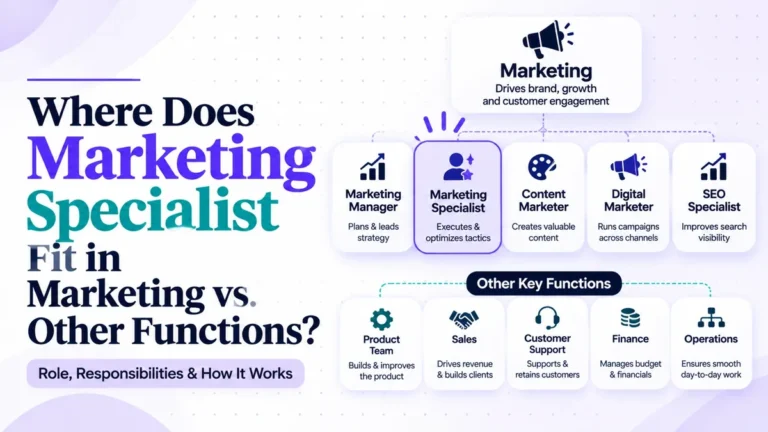
If you are building a store for your services, or your listings tell different stories, I can help you line them up. Whether you are a startup, a small business or a firm selling in the USA, book a free strategy call. For a refresher on the marketing basics behind all of this, read my guide to the 4 Ps of marketing. Still deciding whether to hire a consultant or build a team? See where a marketing specialist fits.
- Review of your Google and AI search visibility
- The pages to fix first, in priority order
- A clear 90 day plan, with no obligation
FAQs
Which category does a digital marketing consultant belong to in ecommerce taxonomy?
In Shopify's Standard Product Taxonomy, a digital marketing consultant belongs under Services > Professional Services > Marketing & Advertising (ID se-7-5). If you need a broader label, use Services > Professional Services > Consulting Services. Google's product taxonomy has no services category, so consulting is not a fit for Google Shopping.
What is the NAICS code for a digital marketing consultant?
The NAICS code is 541613, Marketing Consulting Services. It sits under 5416, Management, Scientific, and Technical Consulting Services. Businesses that mainly create and buy advertising may fit 541810, Advertising Agencies, instead, and broad business advisers may fit 541611.
Can I list marketing consulting services on Google Shopping?
Google Shopping is built for products. Google's product taxonomy has no services group, and its Advertising & Marketing branch only covers brochures and trade show displays and counters. Promote consulting with Google Search ads, local SEO and a Google Business Profile instead.
What Google Business Profile category should a marketing consultant use?
Use Marketing consultant as the primary category. Add secondary categories such as Marketing agency, Advertising agency or Business management consultant only if they match services you actually sell. Google advises choosing the fewest categories that describe your core business.
What schema type should I use for digital marketing consulting?
Use the schema.org Service type for the offer, with serviceType set to a clear phrase such as Digital marketing consulting, and link the provider to your Person or Organization. Schema.org notes the general ProfessionalService type for local businesses was deprecated because it was confused with Service.
Is a digital marketing consultant a product or a service?
A digital marketing consultant provides a service: advice, planning and often hands-on execution. Even when sold as a fixed-price package in an online store, it should be classified as a service, marked as not requiring shipping, and described with Service schema.
Which category should a digital marketing agency choose?
On Shopify the path is the same: Services > Professional Services > Marketing & Advertising. For NAICS, an agency that mainly creates and buys ads usually fits 541810 Advertising Agencies, while one that mainly advises fits 541613 Marketing Consulting Services. On Google Business Profile, Marketing agency is the usual primary category.
Do AI tools like ChatGPT use these categories?
Not by code, but they rely on what your website, listings and reviews say about you. Yext found 86% of AI citations come from sources that brands manage, so using the same category and service description everywhere makes your business easier for AI tools to describe correctly.